Explore the map: Hover over states to see housing readiness grades. Zoom in to see individual factories. Click any factory circle to view its profile. Circle size = jobs, color = grade.
Factory Housing Rankings
73 manufacturing sites ranked by housing readiness
Criteria: Nearby | Metro | Pressure | Amenity
Solid = A/B, Faded = C/D/F
✱
= grouped factories (overlapping areas)
Data Sources:
ACS 5-Year Estimates, BLS QCEW, LODES, Public Records Assessor Data, SafeGraph POI
Methodology:
Factories graded A-F on 4 criteria; overall grade (A+ to F) = unweighted average (2+ F's = overall F).
View full methodology →
× ![Enlarged view]()
Grade Distribution
| Grade | Overall | Nearby Affordability | Metro Opportunity | Economic Boost | Amenity Access |
|---|---|---|---|---|---|
| A | 19 | 24 | 9 | 10 | 30 |
| B | 17 | 27 | 15 | 26 | 11 |
| C | 20 | 16 | 21 | 27 | 12 |
| D | 13 | 3 | 8 | 8 | 9 |
| F | 4 | 3 | 20 | 2 | 11 |
Grades by Industry
How do housing conditions vary across manufacturing sectors? Use the dropdown to compare overall grades or individual criteria.
Interact: Use the dropdown to switch between grade types. Hover over bars to see top 10 factories in each industry.
Readiness Quadrant
Where does each factory stand on the two composite housing dimensions? Click any dot to see the full profile.
- Affordability (X-axis): Nearby housing supply (#1) + Economic Boost capacity (#3)
- Opportunity (Y-axis): Metro growth potential (#2) + Amenities (#4)
Best: High/High
Mixed: High Afford / Low Opp
Mixed: Low Afford / High Opp
Worst: Low/Low
Job Count vs. Factory Grade
America’s biggest factory bets are in its worst housing markets. The pattern is stark: of the eight largest projects in our analysis, none scores better than a C.
The shaded zone highlights the concerning combination of large job counts (5,000+) and poor factory grades (D or F). Projects in this area face the greatest risk of housing constraints undermining their workforce goals.
Interact: Hover over bubbles to see factory details. Click any bubble to view the full profile below.
A Path Forward: The Playbook Potential
The housing picture around these factories isn’t set in stone. AEI’s Housing Playbook identifies regulatory reforms that could unlock substantial new housing capacity.
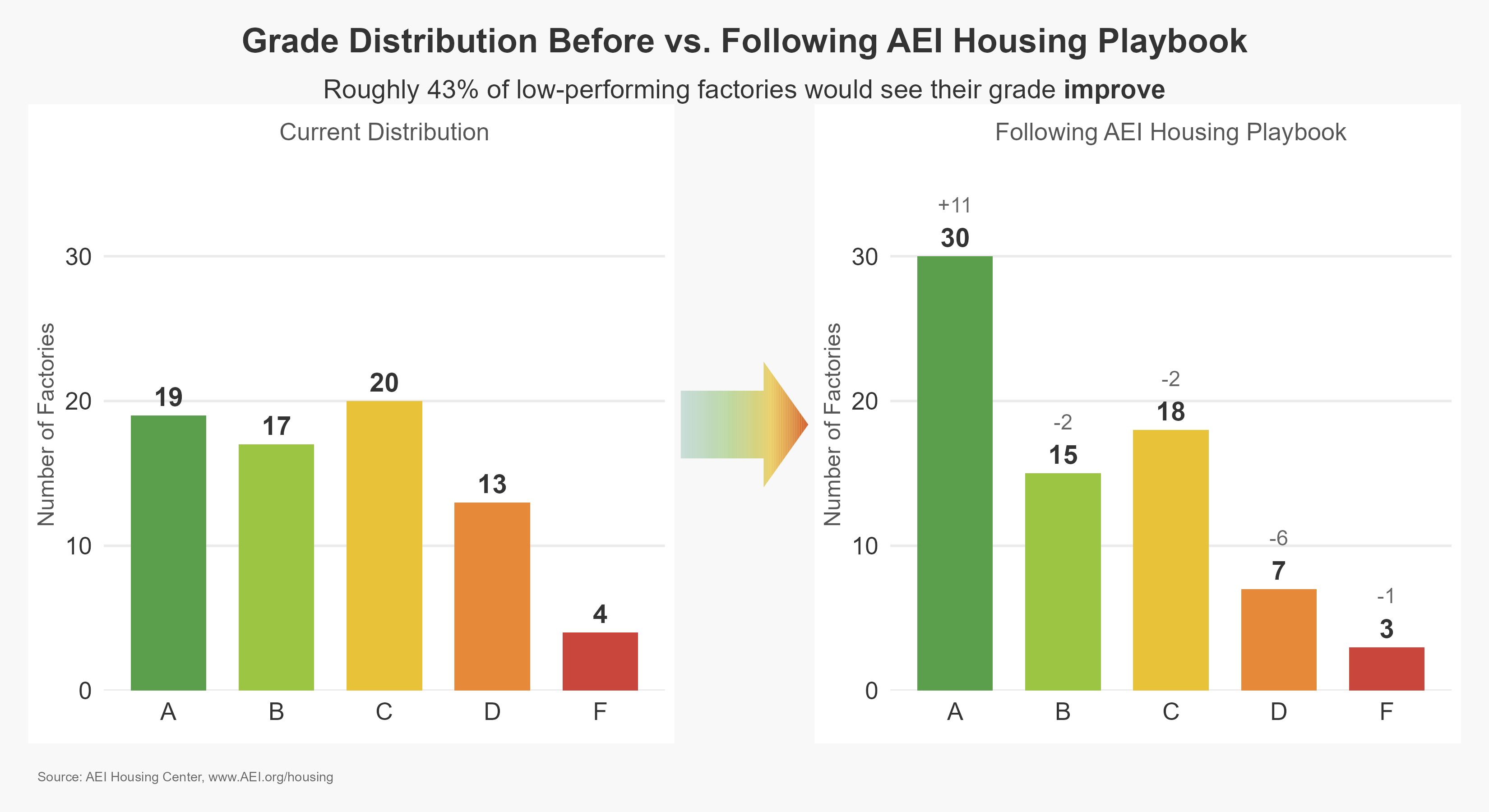
26 factories representing 61,230 jobs could see their grade improve with Playbook reforms - increasing the supply of naturally affordable housing around each factory. Each line below shows one factory’s journey from current grade to potential grade.
If states and localities adopted these reforms, the grade distribution would shift meaningfully—more A-range factories, fewer in the D and F danger zone.